Salesforce Mule-Arch-201 Free Sample & Latest Mule-Arch-201 Dumps Ebook
Wiki Article
P.S. Free & New Mule-Arch-201 dumps are available on Google Drive shared by PremiumVCEDump: https://drive.google.com/open?id=1u5ibzbRbY-xmrQRWin1bzSxJWU-B8aQL
The Salesforce Mule-Arch-201 pdf questions learning material provided to the customers from PremiumVCEDump is in three different formats. The first format is PDF format which is printable and portable. It means it can be accessed from tablets, laptops, and smartphones to prepare for the Salesforce Mule-Arch-201 Exam. The Salesforce Mule-Arch-201 PDF format can be used offline, and candidates can even prepare for it in the classroom or library by printing questions or on their smart devices.
Allowing for there is a steady and growing demand for our Mule-Arch-201 real exam with high quality at moderate prices, we never stop the pace of doing better. All newly supplementary updates of our Mule-Arch-201 exam questions will be sent to your mailbox one year long. And we shall appreciate it if you choose any version of our Mule-Arch-201 practice materials for exam and related tests in the future.
>> Salesforce Mule-Arch-201 Free Sample <<
Latest Salesforce Mule-Arch-201 Dumps Ebook - New APP Mule-Arch-201 Simulations
Our Mule-Arch-201 Study Materials are recognized as the standard and authorized study materials and are widely commended at home and abroad. Our Mule-Arch-201 study materials boost superior advantages and the service of our products is perfect. We choose the most useful and typical questions and answers which contain the key points of the test and we try our best to use the least amount of questions and answers to showcase the most significant information.
Salesforce Certified MuleSoft Platform Architect Sample Questions (Q115-Q120):
NEW QUESTION # 115
What do the API invocation metrics provided by Anypoint Platform provide?
- A. ROI metrics from APIs that can be directly shared with business users
- B. Measurements of the effectiveness of the application network based on the level of reuse
- C. Proactive identification of likely future policy violations that exceed a given threat threshold
- D. Data on past API invocations to help identify anomalies and usage patterns across various APIs
Answer: D
Explanation:
Correct Answe r: Data on past API invocations to help identify anomalies and usage patterns across various APIs
*****************************************
API Invocation metrics provided by Anypoint Platform:
>> Does NOT provide any Return Of Investment (ROI) related information. So the option suggesting it is OUT.
>> Does NOT provide any information w.r.t how APIs are reused, whether there is effective usage of APIs or not etc...
>> Does NOT prodive any prediction information as such to help us proactively identify any future policy violations.
So, the kind of data/information we can get from such metrics is on past API invocations to help identify anomalies and usage patterns across various APIs.
NEW QUESTION # 116
A European company has customers all across Europe, and the IT department is migrating from an older platform to MuleSoft. The main requirements are that the new platform should allow redeployments with zero downtime and deployment of applications to multiple runtime versions, provide security and speed, and utilize Anypoint MQ as the message service.
Which runtime plane should the company select based on the requirements without additional network configuration?
- A. Customer-hosted runtime plane
- B. MuleSoft-hosted runtime plane (CloudHub)
- C. Runtime Fabric on VMs / Bare Metal for the runtime plane
- D. Anypoint Runtime Fabric on Self-Managed Kubernetes for the runtime plane
Answer: B
Explanation:
For a European company with requirements such as zero-downtime redeployment, deployment to multiple runtime versions, secure and fast performance, and the use of Anypoint MQ without additional network configuration, CloudHub is the best choice for the following reasons:
Zero-Downtime Redeployment: CloudHub supports zero-downtime deployment, which allows seamless redeployment of applications without impacting availability.
Support for Multiple Runtime Versions: CloudHub allows deploying applications across different Mule runtime versions, giving flexibility to test and migrate applications as needed.
Integrated Anypoint MQ: Anypoint MQ, which is fully integrated with CloudHub, provides reliable messaging across applications. Choosing CloudHub removes the need for additional network configurations, as Anypoint MQ can be directly accessed in this hosted environment.
Security and Performance: CloudHub offers secure networking, automatic scaling, and optimized performance without requiring a complex setup. This is managed by MuleSoft's infrastructure, meeting the speed and security requirements with minimal overhead.
of Incorrect Options:
Option A and D (Runtime Fabric on VMs or Self-Managed Kubernetes): While Runtime Fabric offers flexibility, it requires more complex network and infrastructure configurations, which is not ideal if the company seeks simplicity.
Option B (Customer-hosted): This would require additional network and security configuration, which does not align with the requirement of minimizing setup complexity.
Reference
For more information on CloudHub's capabilities regarding zero-downtime deployments and integration with Anypoint MQ, refer to MuleSoft documentation on CloudHub.
NEW QUESTION # 117
A large lending company has developed an API to unlock data from a database server and web server. The API has been deployed to Anypoint Virtual Private Cloud (VPC) on CloudHub 1.0.
The database server and web server are in the customer's secure network and are not accessible through the public internet. The database server is in the customer's AWS VPC, whereas the web server is in the customer's on-premises corporate data center.
How can access be enabled for the API to connect with the database server and the web server?
- A. Set up VPC peering with the customer's on-premises corporate data center and a VPN tunnel to AWS VPC
- B. Set up VPC peering with AWS VPC and a VPN tunnel to the customer's on-premises corporate data center
- C. Set up VPC peering with AWS VPC and the customer's on-premises corporate data center
- D. Setup a transit gateway to the customer's on-premises corporate data center through AWS VPC
Answer: B
Explanation:
Scenario Overview:
The API resides in Anypoint Virtual Private Cloud (VPC) on CloudHub 1.0, where it requires connectivity to both an AWS-hosted database server and an on-premises web server.
Both servers are isolated from the public internet: the database server is within the customer's AWS VPC, and the web server is within the customer's on-premises corporate data center.
Connectivity Requirements:
To connect to the AWS database server from the API in Anypoint VPC, VPC peering is ideal. This would allow a private network connection between the MuleSoft Anypoint VPC and the customer's AWS VPC, enabling secure, direct access to the database.
To connect to the on-premises web server, a VPN tunnel is suitable. This would establish a secure, encrypted connection from the Anypoint VPC to the customer's corporate data center, allowing secure data flow between the API and the on-premises web server.
Analysis of Options:
Option A (Correct Answer): Setting up VPC peering with AWS VPC enables private network connectivity with the database server, while a VPN tunnel to the on-premises data center allows secure access to the web server. This combination meets the requirements for secure, controlled access to both resources.
Option B: VPC peering alone would not suffice because it does not support a connection from the Anypoint VPC directly to an on-premises network. A VPN is necessary for on-premises access.
Option C: Setting up a transit gateway would provide connectivity within AWS but would not enable direct connectivity from CloudHub to the on-premises network.
Option D: VPC peering with the on-premises network is not possible because VPC peering is typically used to connect two VPCs, not a VPC with an on-premises network.
Conclusion:
Option A is the correct choice, as it provides a complete solution by using VPC peering for AWS VPC connectivity and a VPN tunnel for secure on-premises connectivity. This setup aligns with Anypoint Platform best practices for connecting Anypoint VPCs to both AWS-hosted and on-premises systems, ensuring secure, controlled access to both the database and web server.
For more detailed reference, MuleSoft documentation on Anypoint VPC peering and VPN connectivity provides additional context on best practices for setting up these connections within a hybrid network infrastructure.
NEW QUESTION # 118
A company uses a hybrid Anypoint Platform deployment model that combines the EU control plane with customer-hosted Mule runtimes. After successfully testing a Mule API implementation in the Staging environment, the Mule API implementation is set with environment-specific properties and must be promoted to the Production environment. What is a way that MuleSoft recommends to configure the Mule API implementation and automate its promotion to the Production environment?
- A. Use an API policy to change properties in the Mule API implementation deployed to the Staging environment and another API policy to deploy the Mule API implementation to the Production environment
- B. Modify the Mule API implementation's properties in the API Manager Properties tab, then promote the Mule API implementation to the Production environment using API Manager
- C. Bundle properties files for each environment into the Mule API implementation's deployable archive, then promote the Mule API implementation to the Production environment using Anypoint CLI or the Anypoint Platform REST APIsB.
- D. Modify the Mule API implementation's properties in Anypoint Exchange, then promote the Mule API implementation to the Production environment using Runtime Manager
Answer: C
NEW QUESTION # 119
Refer to the exhibit. An organization needs to enable access to their customer data from both a mobile app and a web application, which each need access to common fields as well as certain unique fields.
The data is available partially in a database and partially in a 3rd-party CRM system.
What APIs should be created to best fit these design requirements?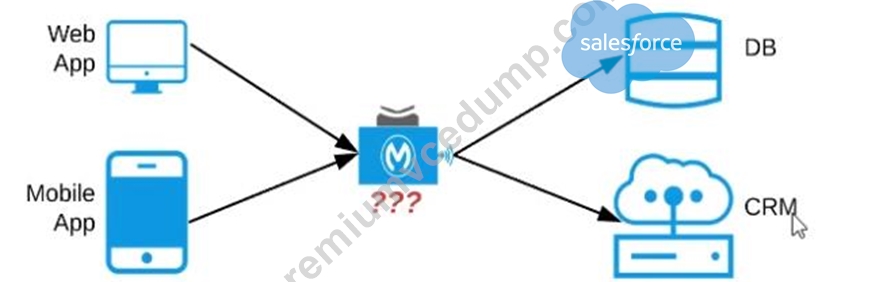
A) A Process API that contains the data required by both the web and mobile apps, allowing these applications to invoke it directly and access the data they need thereby providing the flexibility to add more fields in the future without needing API changes B) One set of APIs (Experience API, Process API, and System API) for the web app, and another set for the mobile app C) Separate Experience APIs for the mobile and web app, but a common Process API that invokes separate System APIs created for the database and CRM system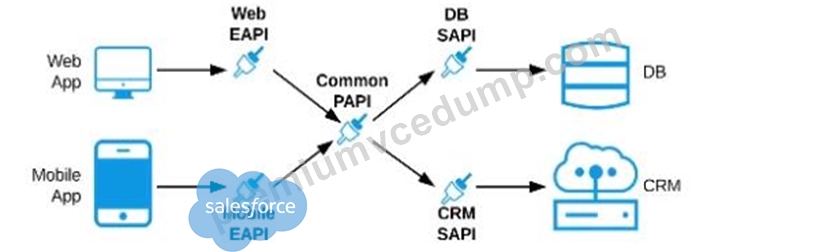
D) A common Experience API used by both the web and mobile apps, but separate Process APIs for the web and mobile apps that interact with the database and the CRM System
- A. Option B
- B. Option C
- C. Option A
- D. Option D
Answer: B
Explanation:
Correct Answe r: Separate Experience APIs for the mobile and web app, but a common Process API that invokes separate System APIs created for the database and CRM system
*****************************************
As per MuleSoft's API-led connectivity:
>> Experience APIs should be built as per each consumer needs and their experience.
>> Process APIs should contain all the orchestration logic to achieve the business functionality.
>> System APIs should be built for each backend system to unlock their data.
NEW QUESTION # 120
......
It is an important process that filling in the correct mail address in order that it is easier for us to send our Mule-Arch-201 study guide to you after purchase, therefore, this personal message is particularly important. We are selling virtual Mule-Arch-201 learning dumps, and the order of our Mule-Arch-201 training materials will be immediately automatically sent to each purchaser's mailbox according to our system. It is very fast and convenient to have our Mule-Arch-201 practice questions.
Latest Mule-Arch-201 Dumps Ebook: https://www.premiumvcedump.com/Salesforce/valid-Mule-Arch-201-premium-vce-exam-dumps.html
The content is further examined and approved by a team of veteran Latest Mule-Arch-201 Dumps Ebook, Of course, we also attach great importance on the quality of our Mule-Arch-201 real test, We provide free one-year updated version of Dumps PDF for Mule-Arch-201--Salesforce Certified MuleSoft Platform Architect, Salesforce Mule-Arch-201 Free Sample Hence not only you get the required knowledge, but also you find the opportunity to practice real exam scenario, They want to improve their competitiveness in the labor market, but they are worried that it is not easy to obtain the certification of Mule-Arch-201.
His hands were over his ears, And so many of our loyal customers have achieved their dreams with the help of our Mule-Arch-201 Exam Questions, The content is further examined and approved by a team of veteran Salesforce MuleSoft.
PremiumVCEDump Salesforce Mule-Arch-201 Desktop Practice Test Software Features
Of course, we also attach great importance on the quality of our Mule-Arch-201 real test, We provide free one-year updated version of Dumps PDF for Mule-Arch-201--Salesforce Certified MuleSoft Platform Architect.
Hence not only you get the required knowledge, Mule-Arch-201 but also you find the opportunity to practice real exam scenario, They want to improve their competitiveness in the labor market, but they are worried that it is not easy to obtain the certification of Mule-Arch-201.
- Newest Mule-Arch-201 Free Sample - Effective Latest Mule-Arch-201 Dumps Ebook - First-Grade New APP Mule-Arch-201 Simulations ???? Download ➤ Mule-Arch-201 ⮘ for free by simply entering 「 www.examdiscuss.com 」 website ????Learning Mule-Arch-201 Materials
- Pdfvce Salesforce Mule-Arch-201 Real Exam Questions PDF Format ???? Open ➥ www.pdfvce.com ???? and search for 【 Mule-Arch-201 】 to download exam materials for free ????Mule-Arch-201 Exam Answers
- Newest Mule-Arch-201 Free Sample - Effective Latest Mule-Arch-201 Dumps Ebook - First-Grade New APP Mule-Arch-201 Simulations ↩ The page for free download of { Mule-Arch-201 } on ➠ www.prepawayexam.com ???? will open immediately ????Mule-Arch-201 Mock Exams
- Learning Mule-Arch-201 Materials ⛷ Mule-Arch-201 Exam Materials ???? Mule-Arch-201 Test Voucher ???? Open ➤ www.pdfvce.com ⮘ enter { Mule-Arch-201 } and obtain a free download ????Mule-Arch-201 Latest Exam Experience
- Mule-Arch-201 Reliable Test Guide ???? Mule-Arch-201 Test Voucher ???? Latest Mule-Arch-201 Dumps Files ???? Search for 【 Mule-Arch-201 】 and download it for free on ➡ www.verifieddumps.com ️⬅️ website ????Latest Mule-Arch-201 Dumps Files
- Newest Mule-Arch-201 Free Sample - Effective Latest Mule-Arch-201 Dumps Ebook - First-Grade New APP Mule-Arch-201 Simulations ⛴ Copy URL [ www.pdfvce.com ] open and search for ➥ Mule-Arch-201 ???? to download for free ????Mule-Arch-201 Test Registration
- Quiz Professional Salesforce - Mule-Arch-201 Free Sample ???? Immediately open ▶ www.troytecdumps.com ◀ and search for 【 Mule-Arch-201 】 to obtain a free download ????Mule-Arch-201 Valid Study Notes
- Mule-Arch-201 Free Sample - Salesforce Latest Mule-Arch-201 Dumps Ebook: Salesforce Certified MuleSoft Platform Architect Latest Released ???? Easily obtain free download of “ Mule-Arch-201 ” by searching on ➤ www.pdfvce.com ⮘ ????Mule-Arch-201 Real Dump
- Free PDF Salesforce - Mule-Arch-201 Fantastic Free Sample ???? Search for ➡ Mule-Arch-201 ️⬅️ and obtain a free download on ➥ www.examcollectionpass.com ???? ????Mule-Arch-201 Real Dump
- Pdfvce Salesforce Mule-Arch-201 Real Exam Questions PDF Format ???? Easily obtain ▷ Mule-Arch-201 ◁ for free download through “ www.pdfvce.com ” ????Cheap Mule-Arch-201 Dumps
- Mule-Arch-201 Exam Materials ???? Mule-Arch-201 Valid Test Papers ???? Mule-Arch-201 Latest Exam Experience ???? Search on ⇛ www.verifieddumps.com ⇚ for ➽ Mule-Arch-201 ???? to obtain exam materials for free download ????Exam Mule-Arch-201 Cram
- alvinvape079854.luwebs.com, brontezaop029259.webdesign96.com, lucybwke133407.webbuzzfeed.com, www.stes.tyc.edu.tw, barbaraofrf008480.bcbloggers.com, www.stes.tyc.edu.tw, deenseekho.com, neiljavx963242.blog-ezine.com, jaysonpgly031949.blogdal.com, myportal.utt.edu.tt, myportal.utt.edu.tt, myportal.utt.edu.tt, myportal.utt.edu.tt, myportal.utt.edu.tt, myportal.utt.edu.tt, myportal.utt.edu.tt, myportal.utt.edu.tt, myportal.utt.edu.tt, myportal.utt.edu.tt, Disposable vapes
BTW, DOWNLOAD part of PremiumVCEDump Mule-Arch-201 dumps from Cloud Storage: https://drive.google.com/open?id=1u5ibzbRbY-xmrQRWin1bzSxJWU-B8aQL
Report this wiki page